








Forecasting the impacts of [micro-]climate change
My general interest is to understand how organisms interact with their biotic and abiotic environments at a spatial scale relevant to the organism. Organisms experience abiotic fluctuations (e.g. temperature) within their microhabitat, but most of the time these fluctuations are not the ones we measure with weather stations at the regional scale. A comprehensive description of the biophysical mechanisms that characterize the microclimate of species is needed, especially if we are to forecast the ecological effects of the climate change to come. Moreover, microclimatic conditions are heterogeneous in space, especially at local scale. Little is known, however, on the impact of such heterogeneous conditions on the population dynamics of organisms and biotic interactions, two key components in community structure and ecosystem functioning. My general aim is to characterize the microclimate of interacting species to estimate its impact on biotic interactions and population dynamics. Further, biophysical modelling of microclimatic conditions can be used to forecast the direction and amplitude of the microclimatic change as induced by global change. Such a perspective obviously appeals to a highly integrated and multidisciplinary approach. I am an ecologist with knowledge in physiological ecology of invertebrates and plants as well as in environmental biophysics.
Microclimate of insect plant relationships
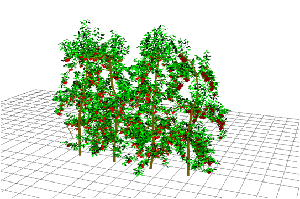
My current project aims at characterizing the microclimate temperature heterogeneity at leaf and tree canopy scale for tiny organisms at the leaf surface such as spider mites and aphids. We study the behaviour and distribution of these herbivores in relation to the leaf surface temperature heterogeneity. Then, a biophysical modelling approach (computing heat budget of spider mites) is developed to predict body temperature of aphids from their position at the leaf surface and from leaf microclimatic conditions. The project focus on thermal processes at both intra-leaf and canopy scales. We integrate the canopy architecture into the mechanistic models. We work mainly with apple trees.
[2013] Read the press release on our MicroCliMite project funded by ANR →
Microclimate of prey-predator relationships
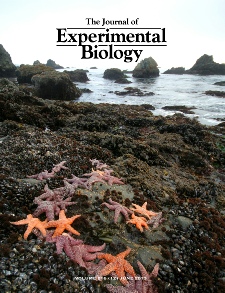
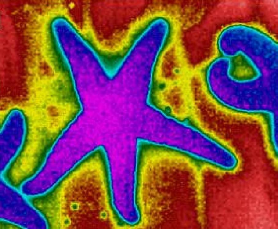
I am also looking at the impact of temporal pattern of thermal exposure on biotic interactions in the intertidal ecosystem, which is thought to be especially susceptible to climate change. The intertidal keystone predator, the ochre sea star Pisaster ochraceus (Echinodermata: Asteriidae), experiences frequent but short periods of exposure to high aerial body temperature (acute exposure) but avoids microhabitats where such exposure is chronic.
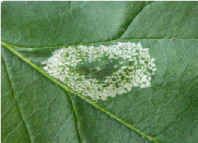
In the past, I also worked on the thermal ecology of an intimate herbivore insect-plant interaction involving a leaf mining moth on apple. The thermal environment of the leaf miner was explicitly modelled in great details to reveal the biophysical mechanisms that set the temperature inside a mine. Micro-measurements indicated that the larva alters the properties of plant tissues, leading to a large temperature excess within the mine. We also revealed the spatial dynamics of the canopy mosaic of favourable and risky microhabitats for the leaf miner as function of regional climate: location of the most favourable microhabitat for insect development is totally reversed during heat wave events compared to periods with more typical ambient temperatures.
Microclimate of aquatic organisms
I am starting a new project that aims at quantifying the spatial and temporal heterogeneity in thermal environment for dragonflies in ponds. Water temperature can vary widely within a pond, and we question whether dragonfly larvae rely on these local thermal variations to emerge. The emergence date of dragonflies seem to change (earlier) because of global warming. However, we want to explore how much pond water temperature varies in parallel with air temperature, and then if local variations can shadow the global effect of climate change.
2009-present. CNRS Research Scientist (CR2), IRBI (France).
2008- 2009. Postdoctoral position, IRBI (France).
2006-2007. Postdoctoral position, University South Carolina (USA).
2002-2005. PhD, IRBI (France).
2008-
2006-
2002-
Keywords:
Biotic interactions; Climate change; Environmental biophysics.
Systems:
Plant-insect relationships; Intertidal ecology; Freshwater ecology.
Organisms:
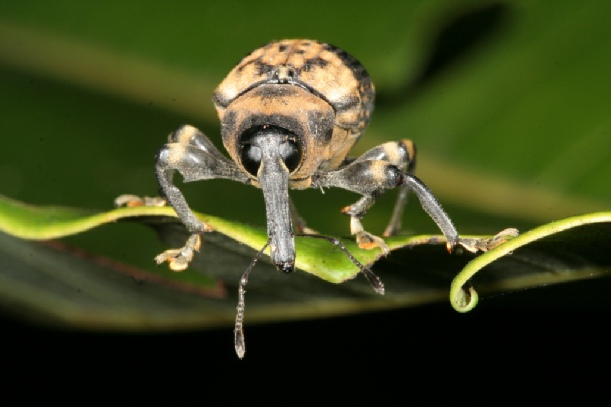
Apple; Bean; Leaf miners; Spider mites; Green aphids; Sea stars; Dragonflies; Dung beetles.
Biotic interactions; Climate change; Environmental biophysics.
Systems:
Plant-
Apple; Bean; Leaf miners; Spider mites; Green aphids; Sea stars; Dragonflies; Dung beetles.
Physical ecology of trophic interactions

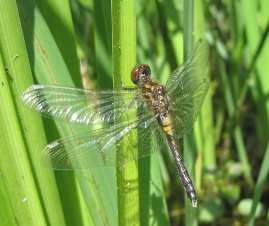
Leucorrhinia caudalis (juvenile)

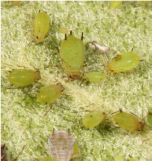
Aphis pomi
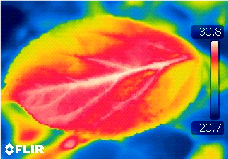
Apple leaf in infrared
3D representation of apple trees
Phyllonorycter blancardella
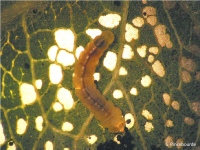
The mine surface

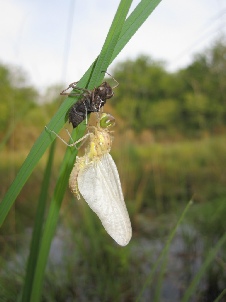
Sympetrum sp.
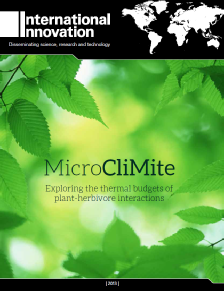
International Innovation is the leading global dissemination resource for the wider scientific, technology and research communities, dedicated to disseminating the latest science, research and technological innovations on a global level. More information and a complimentary subscription offer to the publication can be found at: www.researchmedia.eu
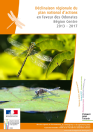
National program for the conservation of threaten dragonflies and damselflies : I have coordinated a synthesis on the health of populations in Region Centre and on the development of a 5-years plan (written in French, however ...).
… just in Love for animals and plants …

Entomological Society Antilles-Guyana


Institut de Recherche sur la Biologie de l'Insecte
UMR 7261 Faculté des Sciences et Techniques
Avenue Monge, Parc Grandmont
37200 TOURS (France)




Under certain circumstances, environmental stress can have positive effects over organismal physiology and reinforces the strength of biotic interactions. I undertake ecological and physiological experiments on this predator to elucidate the relationship between microclimate, body temperature, thermal sensitivities, behaviour as well as feeding and growth rates.

Keywords :
Biotic interactions
Climate change Environmental biophysics